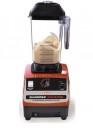
Smoothies are so popular in the West that local and international chains of specialty bars are successfully developing their businesses using them as their primary beverage. While still relatively unknown to consumers in Ukraine, they are already appearing on the menus of establishments of various types: coffee shops, casual and upscale restaurants, and businesses.
food in shopping centers.
The base of a smoothie is fruit, berries, vegetables, and almost always ice. Freshly squeezed juices and low-fat yogurt can also be used. Various additional ingredients are also included: milk (regular or soy), nuts, honey, spices, syrups, tinctures, whey powder, green tea, herbal blends, etc. All of this is blended until smooth. Smoothies are served in a glass, goblet, or bowl, and can be sipped through a thick straw or eaten with a spoon. Fruit and ice blends are an excellent choice for those trying to lose weight; more nutritious blends, such as those made with yogurt, can be a great breakfast or lunch replacement. Smoothies can be made with not only fresh berries and fruits, but also frozen ones and special blends.
The United States is considered the birthplace of smoothies. Fruit and berry drinks with pulp and ice began to be sold
Smoothies were first sold in Californian health food stores in the 1930s. But their mass popularity was brought about by the vegetarian craze that swept the Western world in the mid-1960s. Back then, recipes included fruit, juice, and ice, and less commonly, frozen milk. These shakes were offered in restaurants and health food stores alongside tofu, fruit, carob, and other dietary products. In the early 1970s, the term "smoothie" became established, becoming part of the Smoothie King company name. In the 1980s, smoothies enriched with beneficial minerals and multivitamins appeared, and the first specialized bars began opening. In the 1990s, smoothies began to be made with frozen yogurt, which created a thick consistency, as well as cocktail versions with soda, syrup, and/or alcohol. By the 2000s, smoothie production and distribution in the United States had become an entire industry. Thousands of smoothie bars operate in major cities, collectively generating billions in sales. Bottled smoothies are sold in supermarkets. They have a short shelf life and require refrigerated storage.
and.
"In the US, the production cost of a smoothie is only 10-15 cents, and the retail price is between $2.50 and $4.50," says Yuriy Yeferin, CEO of WESTGATE. "Smoothies appeared in Ukraine several years ago, but they are still poorly represented and have not enjoyed stable demand. Developing this concept in our country is quite challenging, due in part to the product's vague positioning. Various establishments may pass off a smoothie as a non-alcoholic cocktail, a cold dessert, or even a liquid snack. The term itself still hasn't found its own linguistic form in our country: 'smoothie,' 'smoothie,' 'smoothies,' 'smoothies'—there are many variations."
— In Russia and Ukraine, many people believe that the same milkshake, due to its
"It's nutritious and affordable, making it a great alternative to smoothies," adds Igor Maimin, CEO of Marche International. "In reality, a milkshake made with full-fat ice cream is a whipped mass devoid of any beneficial substances. A smoothie, on the other hand, is a healthy product with the purest possible consistency, where the ingredients aren't whipped into a fluffy foam with air bubbles, but rather blended smoothly."
"A blender shouldn't cut ice, but crush it. Otherwise, it's impossible to achieve the smooth consistency and glossy finish that make a drink a true smoothie," notes Maxim Bobrenev, head of the coffee department at Gourmet Style.
"The key indicator of a quality smoothie is a smooth, creamy texture," Yuri Eferin elaborates. "It's worth noting that there are two trends in smoothie making worldwide today. The American concept emphasizes adding as much ice as possible, while European smoothies emphasize fresh fruit. In our country, the development of smoothie culture is hampered by the lack of necessary equipment in most establishments trying to develop this business. The fact is that not every professional blender can make a proper smoothie. And it's not just about the power and speed of the machine. The shape and size of the blade are also important, as is the presence of automatic acceleration modes. Despite the apparent simplicity of the smoothie-making process, each recipe has its own complex mathematics. For example, so-called thick drinks with a large amount of ice require a blender with a power of at least2 l.s. Within seven seconds
The engine should accelerate to 55 percent of its power, then drop to 7 percent. Then, after 3 seconds, it accelerates to 90 percent, maintaining this power until the end of the cycle.
TARGET MIXTURES
TGI Friday's was one of the first smoothie chains in Russia to offer smoothies. Today, its selection includes "Cinnamon Swimmer," "Gold Medalist," "Excellent Ten," "Fun Cyclist," "Tropical Oasis," "Tropical Runner," and "Strawberry Sunrise." Its best-selling smoothie is "Gold Medalist" (strawberry, banana, piña colada mix, grenadine).
"Demand for smoothies is very high, accounting for approximately 70 percent of all non-alcoholic cocktail sales," comments Rimma Boyko, Marketing Director for TGI Friday's. "We don't advertise them separately, focusing on the comprehensive promotion of our cocktails, of which there are over three hundred. We always recommend two cocktails of the day: one non-alcoholic and one alcoholic."
At the HomeMadeCafe restaurant, the menu starts with five mixes that are essentially
Smoothies. Mix #1: yogurt, cherry, and coffee; Mix #2: banana, kiwi, and pineapple; Mix #3: pear, yogurt, ginger, and lemon; Mix #4: yogurt, cinnamon, and apple; Mix #5: strawberry, kiwi, and orange.
"At first, we used ready-made smoothie mixes, but they weren't particularly popular with our guests," says Evgeny Yakovlev, Deputy General Director of HomeMadeCafe. "So we decided to stop buying mixes and started making our own smoothies. Demand for these smoothies is quite high in the spring and summer; they're second only to homemade lemonade in terms of sales in the non-alcoholic beverage category."
Vogue Cafe's signature smoothies are positioned as delicious, nutritious breakfast shakes. These include the signature Vogue Cafe yogurt-berry smoothie, the "Phyto Breakfast" (yogurt, banana, orange, honey, oatmeal), the "Morning Energy" (fig, pineapple, yogurt, honey), the "Fruit Balance" (orange, grapefruit, banana), and the "Refreshing Vitamin C Smoothie."
(yogurt, strawberry, orange, banana).
"Five smoothies on the menu is the optimal selection for establishments that don't specialize in smoothies," says Denis Leontyev, sommelier at Vogue Cafe. "The recipe should include no more than four ingredients to ensure the smoothie has a vibrant, distinct flavor."
At the NKong restaurant, guests are offered aphrodisiac smoothies - Smooth 1 (carrot, apple, celery, quail egg), Smooth 3 (celery, tomato, cilantro, ginseng root) and Smooth 5 (mango, orange, strawberry, dragon fruit), antioxidant smoothies - Smooth 4 (broccoli, arugula, cucumber, tomato, celery) and Smooth 6 (raspberry, blackberry, red currant, honey), Smooth 7 (apple, red currant, honey, lychee), which is good for the heart and circulatory system, and Smooth 2 (pear, orange, apple), which carries a boost of energy.
"We decided to introduce smoothies to the menu at the very beginning of the summer season," says Elena Kolonistova, General Director of the NKong restaurant. "They've taken root well and harmonize perfectly with our Pan-Asian cuisine. So we kept them on the main bar menu. Smoothies have driven up sales in the non-alcoholic beverage category, while juices' share has decreased slightly."
At the Coffee Mania chain of coffee shops, six smoothie-type drinks are offered in the "Not Coffee" section, marketed as non-alcoholic cocktails. These include the best-selling "El Niño" (strawberry, orange juice, and lime), "Dress Code" (blackcurrant milkshake), "La Niña" (orange juice, fresh mint, and mango), "Moscow-Cairo" (vanilla, cranberry, and mango), "Breakfast at Tiffany's" (wild strawberries and strawberries with cream), and "Lady Di" (pear and vanilla ice cream).
NARROW SPECIALIZATION
Last year, the Irish company Zumo Smoothie Bar International entered the market.
Zumo, a company that produces and sells smoothies and natural, freshly squeezed juices. Founded in 2001 in Dublin, the Zumo chain now has more than 60 locations in Ireland, England, Scotland, France, Spain, and South Africa. Zumo Juice & Smoothie bars are currently located in three shopping centers: Auchan Marfino, Auchan Mytishchi, and Mega Belaya Dacha. Plans call for more locations, with the goal of increasing the number to fifty within three years. Smoothie bars require a small footprint (7-24 sq. m), making them ideal for any shopping center. Average daily traffic is 200 people. The selection includes 21 types of juice and 13 smoothies, offered in signature 250, 340, and 460 ml glasses. Prices start at 90 rubles.
The base of Zumo smoothies is macrobiotic frozen yogurt from Ireland, freshly squeezed juices (orange, apple, and pear), and berries. Additional ingredients include pineapple, lime, lemon, mango, papaya, passion fruit, carrot, ginger root, celery stalks, and nut butter. Customers can also choose from a variety of powdered supplements, including vitamins, minerals, goji berries, milk thistle, aloe-echinacea, flaxseed, energy, ginseng, and protein. Ingredients unique to Russia include the Brazilian acai berry, which has a Viagra-like effect, lowers blood pressure, and boosts brain function.
"We collaborate with suppliers of fresh fruits and vegetables from France, Belgium, and Poland," says Igor Maimin. "Professional equipment, including blenders and juice presses that squeeze up to 60 liters per hour, allows us to sell large volumes without pre-preparing anything. To optimize costs, we use the same ingredients in various drinks. Our product range is updated every three months, and the recipes are developed in our experimental lab, headed by our chef. Our current best-seller is 'Strawberry Energy'—a smoothie made with strawberries, orange juice, and yogurt. Also popular is 'Zumo Mix'—a blend of raspberries, blueberries, currants, and strawberries with added orange juice and yogurt. We are currently working with Irish specialists to develop a range of drinks tailored to the tastes of Russian consumers."
Each Zumo smoothie bar is equipped with video cameras, allowing a dispatcher at the head office in Ireland to monitor operations in real time. This equipment is also used for video conferencing on various aspects ofthe business, including the introduction of new drinks to the menu.
The organic café Organiclab is located in the Lotte Plaza shopping center. In addition to smoothies and freshly squeezed juices, it offers organic elixirs and herbal extracts, as well as organic jams, cheeses, pâtés, cereals, and shampoos.
"Each of our customers can decide for themselves how nutritious their drink should be by selecting their favorite fruit from the display case. They will be washed, peeled, and made into either a smoothie or juice in their presence," says Stepan Stoyanov, founder of Organiclab. "A serving (250 ml) of a smoothie made with fresh-frozen fruit costs 25 UAH. If the smoothie includes fresh tropical fruits—papaya, guava, longan, mangosteen, passion fruit, pineapple, etc.—the price can reach 250 UAH. We took the bar's operations very seriously: we importedabout 50 types of powdered supplements and cocktail recipes from the UK and America, and held training sessions. Demand for smoothies is still modest, but we hope their popularity will grow." Perhaps in a few years, we'll open a network of smoothie bars in shopping centers, ranging from 20 to 40 square meters. The estimated payback period, with reasonable rental rates and good footfall, is 8-12 months.