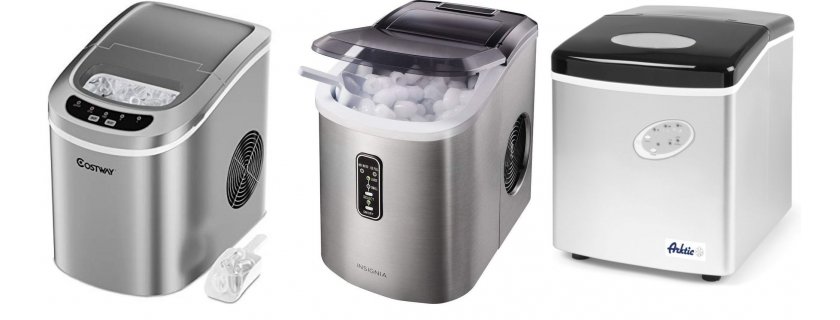
An ice maker is a useful appliance year-round. Of course, it's used much more frequently during the warmer months. But doesn't a birthday party, New Year's, or Valentine's Day need ice for cocktails? However, an ice maker isn't a luxury, but rather a way to add extra enjoyment to life.
The ice maker was invented in the United States in 1850. The device was conceived by physician John Gorey. It was he who, in the mid-19th century, demonstrated the first ice-making apparatus of his own design to the public. In doing so, Mr. Gorey effectively destroyed the then-developed and profitable natural ice industry. However, change didn't happen immediately. Sales of natural, and then artificial, ice finally petered out only in the 1920s, when the first electric household refrigerators arrived in stores.
So what kind of "device" is this—an ice maker? As the name suggests, it's a device for making (generating) ice.
Let's try to understand how it works. Modern units come in two types: compressor and brine. In the former, ice freezes onto the surface of the evaporator. In the latter, water, held in a special mold, is frozen using a circulating brine (refrigerant), whose temperature is approximately 10 degrees below zero Celsius. The latter is less common in Europe and other countries.
Besides the ice production methods, ice makers also differ in the purpose for which the ice is made. This determines how much ice the maker produces and its quality. Professional ice makers , used in restaurants, are naturally much more productive and produce more ice per day. Household ice makers, however, are designed solely to allow the average person to enjoy a glass of juice or a cocktail at any time at home.
Ice makers for cafes, bars and restaurants .
No modern bar is complete without an ice maker. What fruit cocktail can be made without ice? Modern blenders make smoothies with up to 80% ice. For small bars, the standalone ice makers described above are perfectly suitable. For larger volumes, units connected to the water supply and sewer system are indispensable. Our store offers ice makers from Italian brands such as Brema , KASTEL , Scotsman , and STAFF . Years of experience with Brema ice makers have proven their simplicity, low maintenance, and reliability. These are the most common ice makers for bars, with a capacity of 18 to 42 kg per day. The housing of this class of ice makers is typically made of stainless steel. They are easy to connect, easily handled by a regular plumber. If a plumber is not available, our specialists can install an ice maker in any bar. A connection kit is usually included. This type of ice maker is divided into those that produce cube (thimble) ice or flake ice.
Flake ice machines, typically producing 70-90 kg per day, are used to chill fish on special fish tables. The GВ 902A series ice machine, with a capacity of 90 kg per day, is often used for this purpose and has proven itself to be a very reliable machine.
Our company provides a full range of services - from the sale of ice generators to their installation, warranty and post-warranty service.
The article is copyrighted by food-service.com.ua. Copying without citing the source is prohibited.
<The product block will be here>