- Restaurant interior – what significance does it have for the success of establishments in our market? 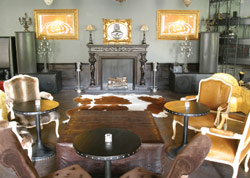
It's not exactly a problem, but in fact, more attention is paid to the interior design of food service establishments in our country than anywhere else in the world. Perhaps this is because the Soviet Union was not that long ago, and for many, visiting a restaurant was initially considered an exceptional event, and exceptional events are usually held in some unusual setting, different from home, and the more different the setting, the more reasons there are to come. Furthermore, if someone comes to a new establishment and doesn't immediately like the interior, they may leave without experiencing the wonderful cuisine or the outstanding service—in other words, without forming a full opinion of the establishment, simply because they don't like the interior or exterior. A successful interior is a technique that not only allows a restaurant to make money but also allows someone who hasn't yet tried anything there to form an opinion.
In general, there are quite a few types of interiors in use, so let's try to classify them. The main type is thematic or conceptual, where a specific theme, image, or mood is selected and reflected in the interior. There are many examples; many restaurants have interiors built according to this type, a thematic approach. For example, the restaurant "Deja Vu" embodied a specific mood in its interior. "Pervak" chose a time period—the early twentieth century—and implemented the decor and color scheme accordingly. "Chasing Two Hares" is dedicated to a specific film. "Egoist" explores the image of an egoist, self-love, photographs of people who were egoists in life, significant figures... a very popular way to express a concept, as it allows for ample scope for decoration.
Another frequently used interior design style is typically associated with a particular cuisine: the ethnic style. For example, a Ukrainian restaurant would be impossible without elements of Ukrainian interior design. There are no Ukrainian restaurants serving ethnic Ukrainian cuisine that don't reflect this in some way in their interiors.
"But there are restaurants with haute Ukrainian cuisine, as they position themselves. Like "Lipsky Osobyan"..."
Let's put it this way: haute Ukrainian cuisine is still a new concept. Especially since they didn't actually choose an ethnic style; they chose the style of the Ukrainian nobility. And Ukraine as a country didn't yet exist; it was Little Russia. They're being a bit disingenuous in their historical perspective here, but nevertheless, the project turned out well. There's Lypky, which has always been a place for wealthy people to settle in Kyiv, and there were certain traditions, although these aren't actually Ukrainian traditions; Ukrainian national traditions are actually rural traditions.
Let's return to ethnic interiors. Japanese cuisine, for example, always incorporates Japanese national motifs into its interior design. This could include zoning with screens, a bright room, table settings, and furniture of a certain color or type. Ethnic interiors are quite popular in their own right.
Beyond attracting customers, the interior has another crucial function – as architects say, it's a challenge to the structure of the space. Simply put, very few restaurateurs can afford to build a stand-alone building where the architect has ample scope for their imagination, allowing them to construct halls of any configuration and buildings of any type, all in a truly convenient manner. Typically, people are faced with a situation where they have a specific space, and if the future restaurateur believes it's suitable for a catering establishment, they begin to play with it and work with it. And here, too, there are certain limitations – if the architect or designer of the restaurant doesn't understand the most important principles of interior design, the establishment could turn out extremely unsuccessful. Therefore, for different types of spaces, there are different interior styles that help retain customers. A classic example is basements; despite the shortage of space, basements still exist even in city centers, and they can be used, and they are correspondingly less expensive than facade spaces. For a basement or cellar space, especially one with low ceilings, you need to be very careful with the concept and ideas, even when it comes to the kitchen, so that people feel comfortable there and can spend money there. Therefore, if the space is a basement, the best option for future development is a beer restaurant or pub.
In such cases, it's desirable that the room, despite being a basement, be decorated in dark tones, using only natural materials—typically wood, dark wood, or a combination of wood and green or beige fabric. Careful attention to lighting is essential. Incidentally, natural light in such spaces is avoided, as it will create the impression of an operating room. Certain interior design techniques can be used to offset the low ceiling—for example, if there are beams on the ceiling, use them or install backlighting to illuminate the ceiling from below, making it appear higher.
Furthermore, basement spaces are zoned so that there isn't just one common room. It's preferable to create small booths or partitioned areas to create a cozy atmosphere. One technique for enhancing such spaces is to create pseudo-windows or even pseudo-spaces, creating niches, such as illuminated windows, or painting a fresco with perspective. This creates the impression that the space is larger than it actually is. Mirrors also help visually expand the space. When I talk about a beer restaurant as the most likely concept, I mean this: a beer restaurant or pub is a type of establishment traditionally located in basements or cellars without access to natural light, creating a cozy atmosphere that entices people to forget the passage of time. This same technique, incidentally, is always used in casinos and the gambling industry in general: there should be no windows or clocks in the room so that the player doesn't sense the passage of time, so that they become engrossed in the game and don't pay attention to the passage of time, and therefore spend more money. 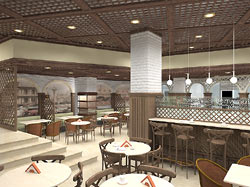
If the concept of a beer restaurant or pub isn't right for you, let's say you don't like the idea, then naturally you can create a restaurant, but again, you should play with the space in a way that doesn't immediately make it obvious that it's just a basement. A good example is the "Captain Nemo" restaurant, which is based on the idea of a submarine, where there's no natural light, and where the aquarium is a way to expand the space, just like the pseudo-windows. This is essentially a pseudo-space, but it's tied to the idea that people don't get the impression they're in a basement, or that they're just "lucky." The key is to find the right way to recreate these corners of the pseudo-space, which allow you to play with the basement. It's possible to create a Ukrainian restaurant in such a space, or a German restaurant, where the interior of a house or cottage is played with. For example, "Tsarskoe Selo," in which the main windowless hall is a former powder magazine, is so well-played with the Ukrainian courtyard, featuring parts of Ukrainian houses, windows, pubs, Cossacks, and wagons, that no one really notices the lack of a single window. Other successful examples of basement interior design include "Dear Augustine" and "Egoist," where there are no windows, but people don't notice because there's a pseudo-space and the playful use of lighting creates the impression of a wider space, eliminating claustrophobia.
There are certain establishments that shouldn't be located in basements—those styles that require natural light. For example, a Japanese restaurant: a basement is absolutely unsuitable for it, as the Japanese style emphasizes maximum naturalism, live plants, natural light, a bright room, light screens, and a light ceiling. A Japanese restaurant in a basement wouldn't be Japanese at all; it would be something entirely different. Furthermore, using any concept involving natural greenery in a basement would also look very suspicious, even if it's live greenery, which would have a hard time surviving in such conditions; it would look very unnatural and unnatural.
Perhaps the best option for a catering establishment is a bright space with large display windows. This is suitable for both a classic restaurant of any kind, even a themed one, and other types of establishments, such as a coffee shop. A classic Viennese coffee shop features large display windows so that people sitting by the window can observe the goings-on outside. Naturally, having such windows in a restaurant is a major plus, as a restaurant is, to a certain extent, a theater, a play. When people sit in a restaurant, eat, and observe the goings-on around them, this naturally prolongs their stay and ultimately increases profits.
Summer terraces serve the same purpose. A summer terrace isn't just an additional service; it's a prerequisite for making money in the summer. Because if a restaurant has a summer terrace, a classic city restaurant can virtually eliminate seasonal fluctuations in customer traffic. Previously, many restaurateurs accepted the summer decline in customer traffic, but many have noticed that with a summer terrace, this impression is almost completely erased. A summer terrace, naturally, should correspond to the establishment's price level – even if it's a mid-priced restaurant, it shouldn't, God forbid, be covered in plastic tables and branded tents from beer or vodka shops. This simply shouldn't happen, not to mention establishments in a more expensive category. 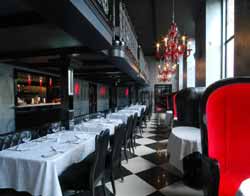
Interior design techniques allow a restaurant to attract customers. One of the key techniques is proper zoning of the dining room. This has its own unique challenges: for example, if the room is a classic rectangular shape, it will feel uninviting to a casual visitor, especially if it's a large room with a high ceiling. While it might be suitable for a banquet, banquets are typically not very common. Therefore, proper zoning of the space is one of the techniques that makes people feel comfortable. This can be as simple as dividing it with partitions. Partitions can be low, say a meter twenty high, or completely enclosing the space if the ceilings are generally low. These can be various artificial structures—houses, tents, etc.—or portable screens.
Our customers are very specific, and they often pay attention not just to the quality of food and service, but also to how free they feel. Not everyone enjoys eating in public. Therefore, if you observe diners in a large dining room, you'll notice that they tend to sit in corners. At the very least, no one sits in the middle of the room, so they can be seen from all sides. In any restaurant, there are always some seats—the "outsiders"—where no one ever wants to sit. Typically, in a large dining room, these are the seats in the center, unless the room is zoned or divided in any way. People will only sit there in the most extreme cases, if there are no other available seats. These are also aisle seats, especially if the seat is facing away from the door—this is psychologically very unpleasant for a person; they can't relax. And even with the most excellent cuisine, they won't feel comfortable.
I've noticed repeatedly that if a restaurant has a spot where patrons don't like to sit, for example, in the middle of the room, then if you add a large palm tree there to visually divide and separate the area, more people will sit there than before. An artificial greenery partition doesn't really cover anything, but people instinctively feel more comfortable there. This approach not only attracts customers but also keeps them there—so they don't just eat quickly and run away, but stay longer, order dessert, wine, cigars, and so on.
There's also a downside: if owners want customers to eat quickly and leave the premises quickly, they can't use zoning; they can't create a truly comfortable space. This is typical of fast food and quick-service establishments. There are techniques to force customers to quickly eat what they've ordered and run away, rather than sit for long. For example, minimal decor. When the walls are practically bare, people won't feel comfortable. The same goes for furniture—it shouldn't be inviting: small tables, so people don't feel the need to sit for long periods of time or engage in lengthy conversations, and uncomfortable chairs without soft cushions.
When I mentioned interior design flaws, I was referring to Zdorovenki Buli, which has a glaring design flaw that, despite its huge seating capacity, is practically never full. People sit for quite a while, as the establishment has soft seating and beer is on the menu. Therefore, there's a temptation to settle in comfortably, and to stay longer than necessary. The next step for a place like Zdorovenki Buli is to raise prices to weed out those people who sit for too long and aren't profitable. For any establishment with a low average bill—whether fast food or quick & casual—it's important for them to have people actually eat quickly and leave. To this end, they almost never have large-capacity seating—if they do have six- or eight-seat tables, they're usually stackable.
Color schemes are interior design techniques that can appeal to people of all ages. For example, it's been repeatedly observed that the younger the consumer, the more they prefer a modern interior—cool tones and contemporary materials—while the older the consumer, the more they appreciate natural materials in the interior—wood, stone, and natural living plants. This is related, for example, to the specific nature of nightclub interiors. A nightclub is a place for a fairly fashionable, young, and active crowd, and a conservative interior made of natural materials will be perceived as old-fashioned by this group of consumers. Therefore, metal, glass, and accent lighting are just what such a venue needs; they will appear trendy and will attract a younger audience and repel older people. Therefore, if a future establishment intends to cater to middle-aged or older customers, it cannot have a modern interior, or even classic high-tech, because these customers will feel unwelcoming. If the establishment is aimed at a younger audience, however, the situation is quite the opposite. This rule is successfully applied in the West, and young people actually frequent such establishments more often. After all, the human psyche doesn't differ across national boundaries.
Incidentally, color scheme is important not only in terms of style but also in its own right. If a company is targeting a more mature audience—middle-aged or older—warm colors in restaurants and other food service establishments in general are preferable, as warm colors are typically associated with comfort and food consumption. This, of course, excludes restaurants with a specific concept, such as seafood restaurants. The perception of fish, and seafood in general, is primarily associated with its freshness, and the colors associated with freshness are green, blue, light blue, and silver. Therefore, to emphasize the freshness of the products on display, it's advisable to use sea greens rather than warm tones (reddish or brick red), which suggest to consumers that the food is simply fresh. This perception factor is precisely why mineral water producers use light blue, blue, and green labels on their bottles, and almost never red or brick red, as these colors evoke different associations. For fast food and quick-and-casual restaurants, for example, the most typical color scheme is shades of yellow and red, as yellow and red are the colors associated with food, especially hot food. This means that warm tones are truly well-received. When used on logos, tableware, and furniture, they help attract customers.
How acceptable are global interior design trends for Ukraine? Will our visitors perceive interiors in line with any contemporary global trends?
I know many people have different opinions, but I've identified two main trends. I'd call the first trend antique, and the second, pared-down modern. The antique trend is more typical of Europe, especially European restaurants, where they carefully preserve any traces of history. For example, if a pub is three hundred years old, the owners try to preserve the interior and furniture, even if it's disparate and of different styles, even the dishes from a hundred, two hundred, or three hundred years ago. And this is highly valued. I encountered a situation in Paris where, when you go to a restaurant in a clearly old building, it smells like an antique shop, because the furniture is antique, real antique furniture—not just stylized, as we do here, but genuine, with the characteristic scent of antiquity. I, for one, like this smell, although I know it puts many people off.
- We just have a different story...
Yes, we have a lot of preserved antique furniture and tableware, but people here haven't yet learned to appreciate it. If you take Europe, for example, any antique chair, even if it's not in the best condition, is valued simply because it's an antique, because it has a history. That's one trend—when history is protected and carefully preserved. If we follow this trend in our country, we have pseudo-antique or pseudo-historical establishments, but it's probably impossible to create truly authentic antique establishments here. Firstly, people often don't perceive this, and secondly, if someone comes to a restaurant and the furniture is disjointed, it's unlikely they'll be convinced that this is simply because it's all antique and was collected from different places. They'll think the restaurant didn't have enough money to buy a set. Or antique plates... Antique tableware—a great deal of it has survived, but if the cutlery on the table is different, people will perceive, again, that the restaurant didn't have enough money to buy proper tableware. Therefore, we can't fully implement this trend. Although there are attempts, and very successful ones, at pseudo-antique interiors. There are many such examples both in Kyiv and throughout Ukraine: when a certain time period is used, for example, the early 20th century, the 19th century, the Middle Ages, or the Kievan Rus era, a stylization is created to resemble a specific historical period. This may not involve a single original item from that era. Take the "Lipsky Mansion," for example...
- Or "Pervak"...
- Not exactly - at Pervak we have all sorts of irons and samovars that are truly original: we have a lot of this stuff and it's quite cheap, so it's something people buy.
The Khoryv restaurant, which evokes the Kievan Rus era, has a very interesting interior, but its princely chambers, naturally, lack a single item from that era. Thus, the antique trend in interior design exists in our country in this pseudo-form, but it's not widely represented.
The second trend... When I talk about the trend of a lean, modern interior, I mean that in the world, I'm talking about developed countries, people go to restaurants to eat, that is, as a rule, specifically to eat. There is no goal there to impress business partners, no goal to surprise a girl or show off to friends...
"I think this trend is based on the fact that many are tired of overstuffed interiors and want something simpler... Customers at such establishments are jaded by the beauty found in every restaurant with a specific theme. A pared-down, modern interior is simply a response to this."
"A restaurateur should never think they're smarter than their customers, because this new-style restaurant has only been around for 10 years; they didn't appear before the end of perestroika, say, while the oldest commercial restaurants are 11 years old. But that's very young—not a hundred or two hundred years. Such a minimalist, modern interior appears in establishments that don't spend much on interiors at all: they spend primarily on the kitchen, and people come there specifically to eat. And the setting isn't particularly important to them. Of course, it's not a dump, but everything should be fairly modest and, most importantly, stylish. That is, a certain style and color scheme are chosen, but without the overabundance of decor that we have. In general, our restaurants often suffer from overabundance of decor. We—Russians and Ukrainians—have a slightly different mentality... The more decoration in the interior, the more a person is willing to pay. When a restaurant has scant decor and a high bill, it's generally perceived as a bad thing; it's associated with fast food. Because only fast food restaurants can afford to simply paint the walls, hang a few pictures, and call it a day—the main thing is that it's clean and hygienic, and sanitary. Restaurants, on the other hand... If a restaurant charges a high price but the interior is rather sparse: the finishes may look expensive, the panels may be expensive, the flooring and ceilings may be expensive—but without decor, it's still quite sparse. It could be decorative objects, or backlit decoration, or colorful panels... without decor, the restaurant looks quite sparse. Then, for the consumer, unless they're a connoisseur of the cuisine being served, or a gourmet, it's very difficult to understand why a restaurant that didn't spend much on the interior charges such a high price on the menu, why this dish costs 100 hryvnia, what people did to make it cost 100 hryvnia.
- Maybe this attitude will change over time?
I read an interview with Saveliy Lipkin, a well-known Odessa restaurateur and a very interesting person. He predicts that in five to seven years, establishments will appear with sparse interiors and an emphasis on cuisine. I'd say it won't be five years, but 15 to 20 years, before a new generation grows up who will frequent food establishments. For now, at least, the bulk of people visiting such establishments are people born during the Soviet Union, and, whatever one may say, these trends will continue until that generation ages out and a new generation of patrons emerges.
- Still, this is also connected with the general culture of society... Our people are not yet satiated with all the benefits that fell upon them along with the collapse of the Soviet Union... When there is satiation, then there will be a different attitude.
- For the generation that is now the most active in life, including in visiting restaurants, the desire to live and eat in more or less luxurious conditions may never go away.
Therefore, if a restaurateur wants to truly make money from the most active segment of the population, they must think very carefully about the set design, because a restaurant is, to some extent, a theater in which everyone plays a role—the chefs, the waiters, and the customer. They, too, play a role, they are drawn into a specific game—they arrive, order a dish, the ritual of service begins, they consume, wipe their lips with a napkin, pick their teeth with a toothpick—that, too, is a certain ritual. And a theater without a set design is impossible; there are no theaters without sets. Therefore, as long as restaurants are perceived as theater, we will have sets. And there will be few establishments where the food is excellent, but the interior is inferior due to the lack of set design—ones where people truly appreciate the food…
I also wanted to talk about furniture. Naturally, furniture in a restaurant, as in any food service establishment, is also a way to retain and attract customers. Recently, I've been talking about and personally observing in my lectures that at an unset table, meaning without a tablecloth, people behave completely differently than at a set table—with a skirt and a tablecloth. If the table is simply wooden, even if there are cutlery on it, even if there are place settings, people can sit, rest their elbows, lie down, and even stretch out on it. A set table, however, with a tablecloth, requires the behavior we've been taught—a straight back, elbows close to the body—meaning there's no way a person will slump at such a table. Therefore, if a restaurant or cafe is democratic, then you can do without tablecloths altogether, you can limit yourself to just sets, it doesn’t matter whether they are cork or fabric, or without it at all – just a bare table, because at such a table a person will behave more relaxed, more democratically.
Chairs... For someone to sit for an hour and a half to two hours, or even more, in an establishment, spending their money, they need to feel comfortable, so their back and butt don't hurt. To achieve this, even if the chairs are ordinary, they have upholstered cushions, padded backs, and some even use fur upholstery. At O'Panas, they used fur. They laid white fur on the bench, and people couldn't get rid of it—it was cozy, pleasant, especially when it was cold outside. It's a seemingly banal technique, but it actually makes a significant difference.
The bar counter is also often used as a decorative element, and in very interesting ways. There's a concept called a working bar counter and a non-working bar counter. If a restaurant has limited space for a bar counter or doesn't emphasize bar products, the counter can be small, and people may not even sit at it. For people to sit at the bar, it needs to be long enough and preferably have some unique configuration. It doesn't necessarily have to be straight, so people sit in a row like hens on a roost. The best option is an arched or round bar counter with comfortable seats to encourage people to sit at it and, again, spend their money. I don't sit at the bar – my legs usually dangle, and it's uncomfortable. For people of short stature, the bar counter is not convenient, there are some nuances like these.
It's important to remember that if you have a specific space and want to create something—a coffee shop, a beer bar, a restaurant, a children's cafe, etc.—the space itself may be suited to a completely different concept, a completely different interior. Therefore, when creating new businesses, not only do you need to analyze the market and competition, but you also need to take a closer look at the space itself: what concept will best fit it. Because when a restaurateur "forces" the space, the effect is such that when you enter the establishment, you feel: "This was definitely supposed to be something different. People clearly made a mistake with the interior, giving in to their secret desires to do it this way, and the space is designed for a completely different enterprise." In such a case, the enterprise will never succeed. The entire concept must be coherent: the price, the cuisine, and, most importantly, the interior. In general, a lot is said and written about interior design, because it's a way to make money. Oddly enough, this is precisely how consumers perceive it: not just the cuisine and the dish itself, but also the environment in which the food is consumed. If this doesn't meet expectations, then, in our environment, the establishment can hardly be considered successful.


