- First, a bit of historical background. Did the restaurant originally appear at the hotel, or have there always been one? 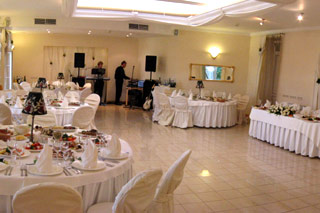 independent catering establishments?
Hotel restaurants appeared earlier than independent ones. However, the word "hotel" isn't quite appropriate here, as modern hotels evolved from inns, which always had some kind of tavern attached. Hotels, however, continued this tradition, recognizing that those staying there needed somewhere to eat.
A modern hotel is unthinkable without a restaurant, as breakfast is usually included in the price of a stay. Furthermore, a restaurant isn't a charity canteen, but a business for making money. Hotel restaurants serve both guests and the general public. They are typically the most expensive restaurants in town. This isn't always the case in our country, but there are some worthy examples, such as "Empire" at the Premier Palace.
What are the special features of a hotel restaurant? How is it different from a regular restaurant?
- First of all, the strict obligation to feed guests. This means that at least once a day, usually in the morning, from about 6 to 10 a.m., the restaurant is open exclusively for in-house use. During this time, a serving line is available, and less frequently, guests are offered an à la carte breakfast menu. If a restaurant wishes to continue serving outside customers during this time, it must have a separate dining area for guests, closed to outsiders. This is perhaps the most distinctive feature of such a restaurant.
In addition, the equipment must be designed for serving guests' morning meals: a serving line (for cold and hot appetizers, electric kettles, coffee grinders, and coffee makers) must be purchased. Appropriate utensils must be available, such as large platters, serving utensils, kitchen utensils, and equipment for transporting food to the halls and rooms.
Another difference, invisible to the outsider, is that many hotel restaurants play a secondary role, including in their profit structure (the main source of income is accommodations, followed in descending order by restaurants and bars, conference rooms, saunas, fitness centers, and spas). Often, a hotel restaurant is virtually uncrowded during the day, but is used for large banquets and receptions. Therefore, if you visit such a restaurant on a typical weekday, it will most likely be empty. Meanwhile, for the next few months, every weekend may be booked for banquets.
- Is the symbiosis of a hotel with a restaurant similar to the coexistence of a restaurant and a casino, a restaurant and a nightclub?
All three cases share a common thread: the restaurant doesn't play a major role in either revenue generation or marketing. If a complex includes a casino, it's like a vampire, absorbing the bulk of the revenue, while the restaurant is relegated to a "service" role. A nightclub restaurant is often well-attended, but patrons rarely eat there. The main products consumed are alcoholic and non-alcoholic beverages, and light cold and hot appetizers. Full meals are uncommon in nightclubs, so the menu is appropriately small and light. An exception are country entertainment complexes, which offer hotel rooms and various additional services, but the restaurant always plays a key role.
- What proportion of the hotel restaurant's audience are customers "from the street"?
There's a pattern: for a hotel restaurant to be considered more than just an in-house establishment, it needs a separate entrance, a distinct name, and a separate advertising campaign. If the restaurant isn't branded separately from the hotel, it will be perceived as part of the hotel's services. If the restaurant doesn't have a separate entrance, the likelihood of being visited by people "off the street" is approximately 10%. Taking all these patterns into account, the number of non-guests increases dramatically, reaching up to 70% of the total audience. An example of such a successful establishment is Sumosan at the Premier Palace.
Another category of clientele for such restaurants are those who order banquets and buffets. Almost all hotels built in the 1970s and 1980s have huge banquet halls (seating 500-1,000). People rarely go to such restaurants just to dine; the huge, uninviting halls are intimidating, but when choosing a banquet venue, such halls are ideal. Given that banquet and buffet orders have increased by 50 percent or more in recent years, there is a significant shortage of large halls. Restaurants with a single, large hall where everyone can see each other are especially lacking. Such hotel restaurants generally don't rely on feeding people off the street. Their business is built on feeding guests and hosting banquets.
How developed is our hotel and restaurant industry compared to Europe? How will it develop in the lead-up to Euro 2012?
The underdeveloped hotel industry is a pressing issue, not just in light of Euro 2012 – there's been a shortage of hotel rooms for a long time now. This applies to all segments: both high-end (4-5 stars) and mid-range (2-3 stars). The Hyatt Regency Saint Sophia Hotel on Sophia Square will soon open (editor's note: the hotel hadn't yet opened at the time of this interview), followed by the Golden Domes a little later. Both are high-end hotels, and will attract some of the Premier Palace's clientele, which is currently almost always full. The mid-range segment still consists of mostly outdated hotels whose quality lags far behind European standards. Overall, Kyiv currently has about 120 hotels. The demand for 4-5 star rooms is three times greater than what currently exists, meaning the two hotels that open won't meet demand. Consequently, hotels of this standard will be rapidly emerging over the next five years. The shortage of 2- and 3-star hotels is not so severe: people are willing to pay a little less and stay in older rooms. In this segment, the number of rooms will soon double, and the older rooms will also be renovated.
Are the restaurants at these hotels of sufficient standard? Will they be improved?
Restaurants at 2-3-star hotels haven't changed much since Soviet times. Many people are quite happy with them: they book banquets there. That's their main source of income, and there's no point in working on the menu, staff, or advertising. However, I think the situation will change soon. Countryside complexes with large halls are being actively built, and catering services, which can be ordered to any location, are flourishing. With each passing year, outdated restaurants have less and less chance of operating normally. Because there are competitors with large halls, beautiful interiors, decent service, and reasonable prices. But this won't happen anytime soon, as there's still demand for restaurants with Soviet-era service.
As for new restaurants opening in 4- and 5-star hotels, they are usually of a very high standard.
- Are there any three-star hotels (and restaurants attached to them) in Europe that are of the same standard as ours?
Europe has everything you could want. The number of low-quality establishments versus high-quality ones varies greatly from country to country. Even the actual level of accommodation matches the star ratings they claim to offer varies from country to country. In Germany, the Czech Republic, and Poland, three-star hotels are comparable to our four-star hotels. That is, 2- and 3-star hotels in Central and Eastern Europe are quite high-quality. Many of their restaurants also boast delicious cuisine, beautiful interiors, and excellent service, but they're not particularly popular with the locals. It seems to me, however, that banquets are booked much less frequently there than here. The CIS countries are more active in booking banquets. In Europe, when people want to celebrate something away from home, they often simply go to their favorite restaurant, without setting out to invite two hundred people at once. Weddings are, of course, an exception, although the goal isn't to overfeed and overdrink everyone, as is common here.
- What do domestic hotel and restaurant managers need to learn?
- Maintaining standards. Especially service standards. Many complain about a staff shortage, both for regular city restaurants and for hotel restaurants. As a result, even hotels rated above three stars often employ less-than-qualified staff, leaving managers with no choice but to hire less-than-qualified people and train them further. But hotel managers often don't even bother implementing standards or monitoring staff not only in financial matters but also in their interactions with customers. And why bother? Guests will come anyway, after all, they have limited choice. Unfortunately, it's precisely in the hotel industry in Ukraine that so many vestiges of Soviet service traditions remain.


