The History of Cotton Candy
English (American) name Cotton candy is closest to ours - cotton candy, although in the US they used it before Another name is fairy floss , as it is now in Australia. In England, something in between the two has taken hold: candy floss . It's interesting to know the meanings of the translations of these words: cotton ; candy ; floss ; down; fairy ; magical, graceful, transparent, thin.
In France, cotton candy is called An interesting word is barbe a papa , i.e. father's beard; in Germany it is Zuckerwolle , or sugar wool (yarn); in Italy it is zucchero filato , i.e. sugar yarn (thread).
The Origins of Cotton Candy
Confectionery products in the form of threads obtained from molten sugar have been known for a long time.
There are stories (legends) that the ancient Romans had people who knew how to make similar sweets. If there's even a grain of truth to this story, it makes cotton candy one of the many arts (technologies) lost during the Middle Ages. This art reappeared (or perhaps first) in the mid-18th century. However, the manufacturing process was manual and extremely labor-intensive, making cotton candy expensive and therefore inaccessible to the common man. In the East, there are similar confections, such as the Persian pashmak and the Turkish pişmaniye , although the latter is made with flour in addition to sugar.
For a product to be accessible to everyone, it must be affordable. Raw materials are no problem—sugar is relatively cheap and requires little per serving. The issue is labor intensity and production speed. To make cotton candy a truly mass-produced product, it was necessary to mechanize the production process and create a machine for rapid production. And such a machine It was created in the United States in the late 19th century. Although in the United States, the question of who invented the cotton candy machine has been a subject of debate for many years. According to The Dictionary of American Food and Drink , Thomas Paton introduced cotton candy to the public at the Ringling Brothers Circus in 1900.
There is also information that around the same time, a dentist from New Orleans, Joseph Lasko, introduced this interesting confectionery in his dental office. However, this dentist didn't think to apply for a patent, thereby depriving himself of priority for this invention.
The Canadian confectionery company Tootsie Roll Industries, Inc. (or, according to other sources, Tootsie Roll of Canada Ltd.) claims that the device it produces, called " Fluffy Stuff ," was first presented at the World's Fair in 1893. But there is no convincing evidence of this fact anywhere.
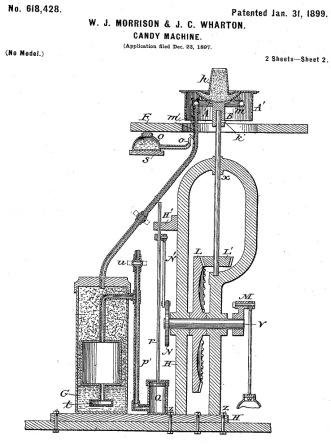
Therefore, it is generally accepted that William Morrison and John C. Wharton invented the cotton candy machine. There are two solid reasons for this claim. First , there is U.S. Patent No. 618,428 , the filing date of which (December 23, 1897) is considered the date of the invention of the cotton candy machine. The production method and the setup itself are simple, almost to the point of genius. Melted sugar, heated by a gas burner and contained in a rotating container, was forced by centrifugal force through small holes or a mesh on the periphery of the container. Caught in the air flow from a fan, thin streams of molten sugar instantly crystallized into fine threads, similar to cotton wool or wool, and were collected by the operator onto a wooden or cardboard stick to form a ball. The rotation of the sugar container and the air blower was carried out using a foot drive, similar to those used in sewing machines.
The first electric machine for producing cotton candy.
Patent US Patent No. 717756. Candy Machine. Patented January 6, 1903 |
|
Secondly , to introduce the new product to the public, the inventors chose the 1904 Louisiana Purchase Exposition , otherwise known as the 1904 St. Louis World's Fair, where the Electric Candy Company earned $17,164 by selling 68,655 boxes of cotton candy (370 boxes for each day of the exposition) at a price of 25 cents .
Called Fairy Floss by its inventors and packaged in brightly colored chipped-wood boxes (probably made of wood or veneer), the new product enjoyed immense popularity, despite its high price for the time. Suffice it to say, admission to the fair, which included access to all its attractions, cost 50 cents, and some department stores at the time advertised men's shirts for 25 cents.
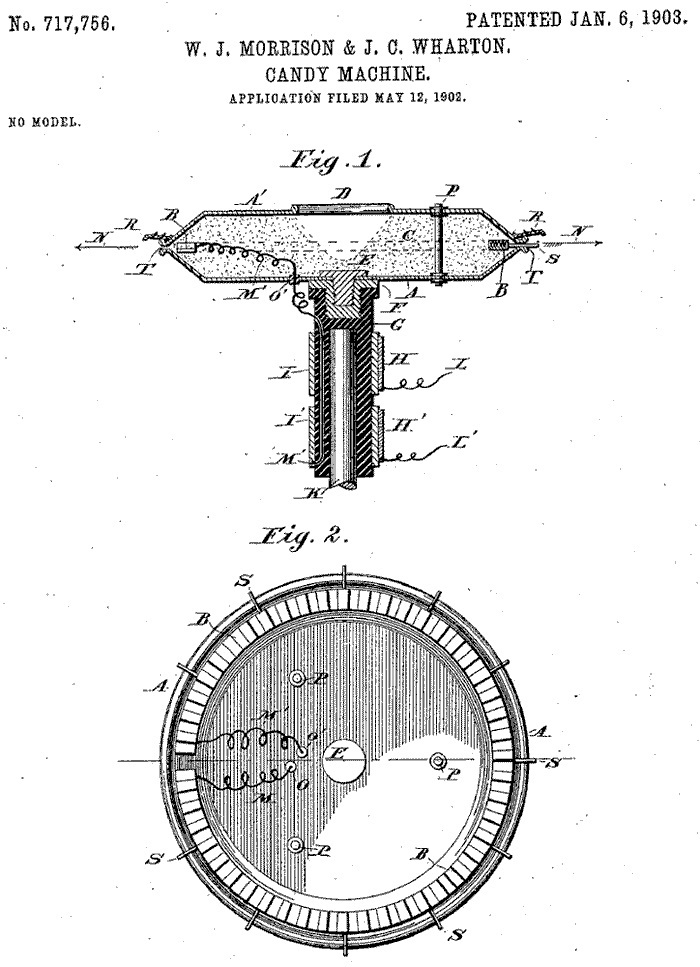
Almost all sources claim that the cotton candy sold at the St. Louis World's Fair was made using electric machines, and that Morrison and Wharton are credited with inventing the electric apparatus for its production. However, patent No. 618,428 makes no mention of the use of electricity, either as a heating element or as a drive. The fact is that by 1904, the apparatus had been significantly improved, including being electrically heated, as evidenced by this drawing from U.S. Patent No. 717,756 , which the authors received just in early 1904.
|
The first electric machine for producing cotton candy.
U.S. Patent No. 717756. Candy machine. Patented January 6, 1903 |
It's worth noting that the 1904 World's Fair in St. Louis was a landmark event not only for America but for the entire world. In terms of food, it was at this fair, in addition to cotton candy, that the famous Hot Dog sandwich, iced tea, ice cream rollers and cones, and peanut butter confections first appeared—products without which it's hard to imagine modern America.
Following this fair, the cotton candy industry boomed. New companies emerged, producing various types and models of cotton candy machines. In addition to electric machines, gas-heated and hand-operated ones were also produced. At the beginning of the 20th century, this was the most popular model. It was produced, for example, by the Chicago-based Empire Candy Floss Machine Co. To boost sales of its machines, the company offered a free book (or manual) with a detailed description of the machine, production technology, and business management. Here's an interesting advertisement:
Write quick for our book. It tells you how to start in this Big Money Making Business that makes 1000% profit with small amount of money. Big discount in unrepresented territory. Don't delay. Write today.
Write immediately , so that get The book will tell you how to get started in this Big Money-Making Business, which brings in 1000% profits with a small amount of money. We offer deep discounts in territories where we don't yet have a presence. Don't delay. Write today.
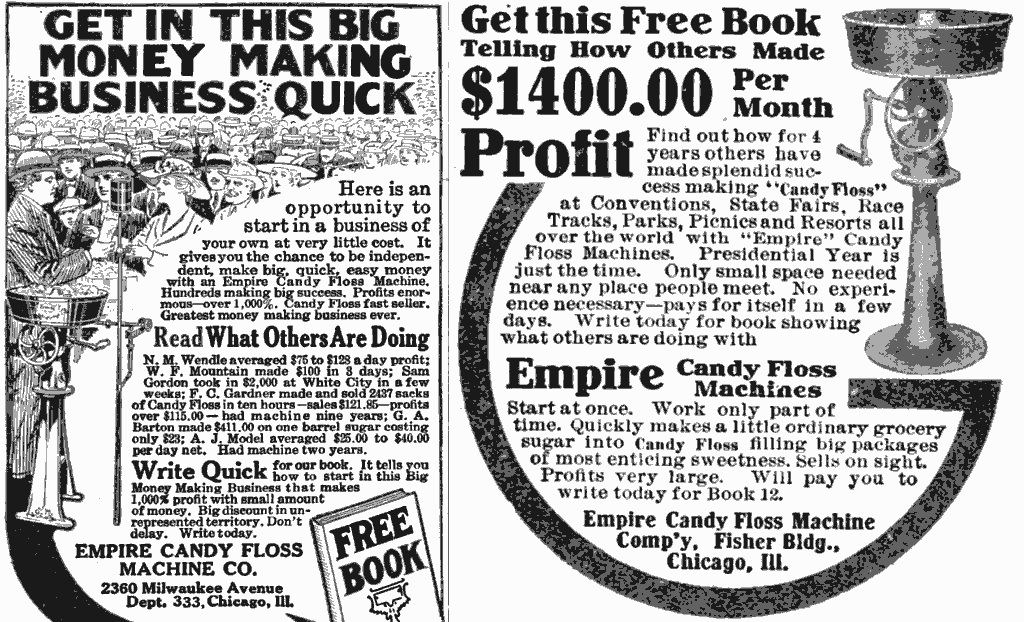
|
Early 20th century advertisements promoting cotton candy businesses. |
Here are more images of candy machines from 1905 patents. Apparently, the World's Fair served as a great boost for this type of business, since so many patents were registered within the next year, even though applications for them were filed while the fair was still in operation.
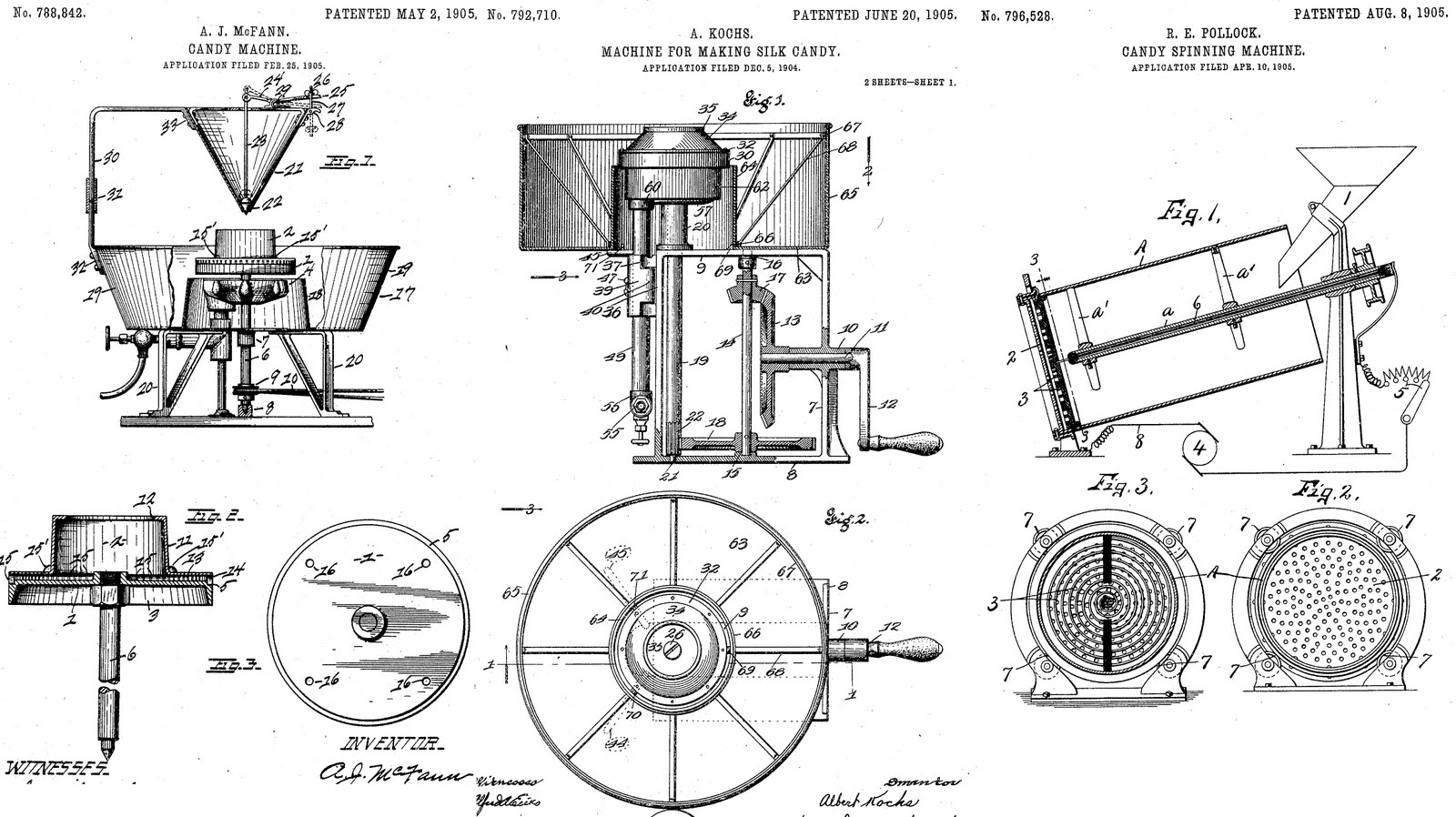
|
1905 US Patents Nos. 788842, 792710, 796528. |
As often happens, the cotton candy inventor duo, as well as their company, Electric Candy Company, didn't last long. The reason for their split is unknown to me, but Morrison himself received the next U.S. patent, No. 816,114, in March 1906. The company was divided and renamed, but it survived. Here's an advertisement for Electric Candy Floss Machine Company, Inc., from the mid-20th century.
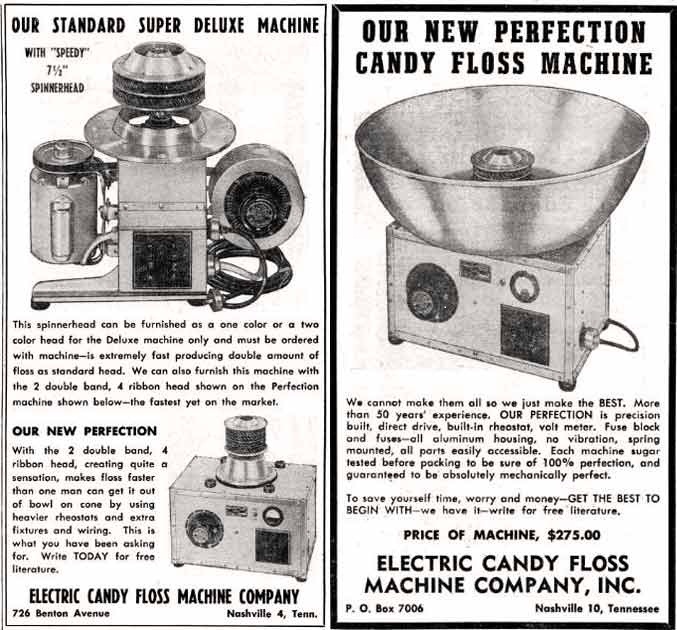
|
Products companies Electric Candy Floss Machine Company, Inc. 50 's 20s centuries .
Based on materials from Billboard magazine. |
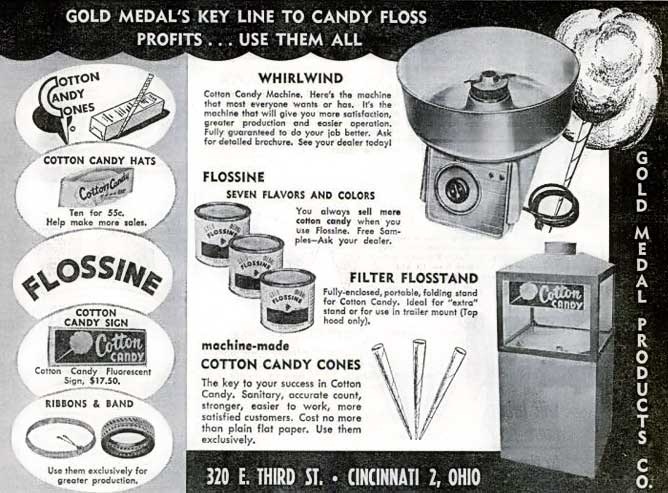
The leader in cotton candy machine production from the mid-20th century to the present day is Gold Medal Products Company, Inc. (Cincinnati, OH). Here's a 1950s advertisement on the topic. It's noteworthy that this was no longer simply selling a single machine, but offering a comprehensive service that included various components, consumables, accessories, and more, right down to the tent itself.
Here's the latest patent, owned by Gold Medal Products Company, Inc. Of course, the gap between these two machines is enormous, both in time and technology, although, strictly speaking, the operating principle has remained virtually unchanged.
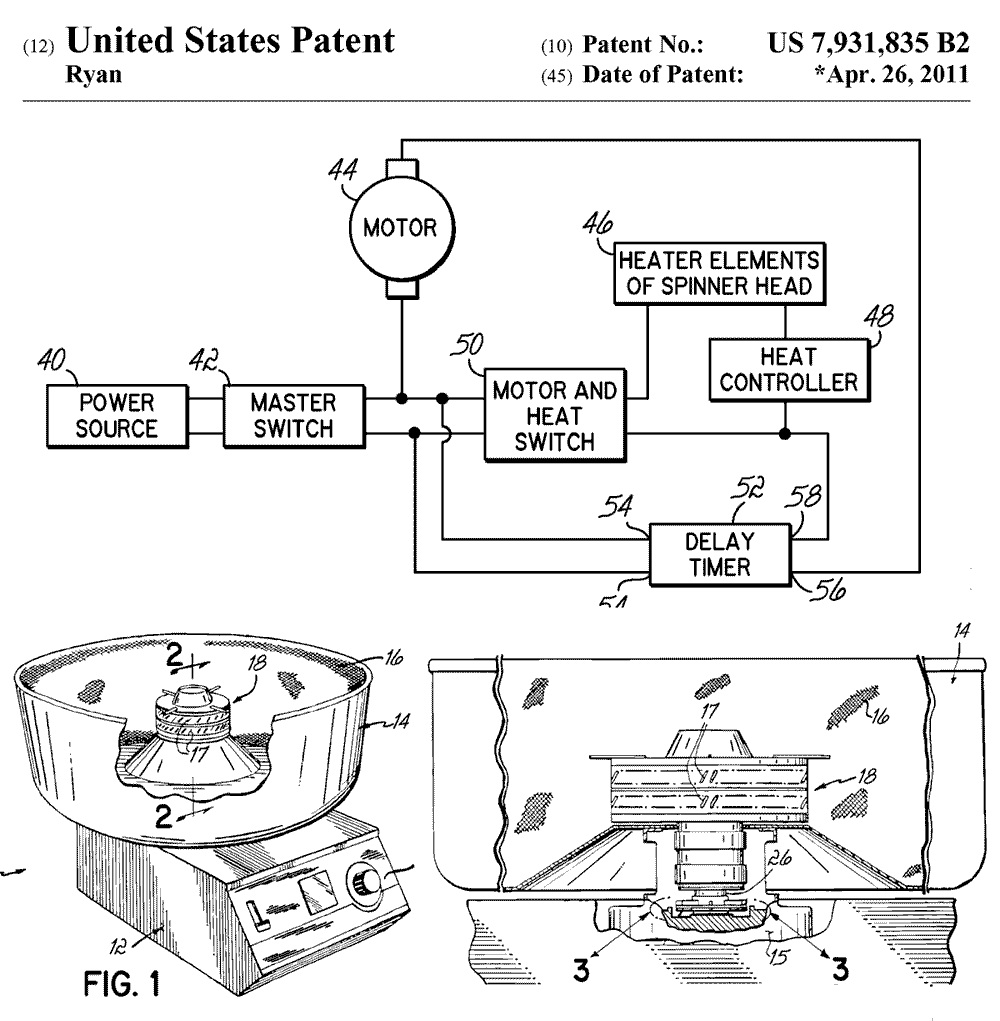
|
Patent US No. 7931835. Heater control for cotton candy spinner head. |
However, cotton candy itself has certainly changed. A major advance in cotton candy production technology is the development of color, aroma, and flavor in this product. Although these advances seem dubious in today's world, with its phobias about artificial colors and flavors, packaged cotton candy made from pure sugar is now difficult to find. For example, the aforementioned Canadian company Tootsie Roll produces its well-known Fluffy Stuff Cotton Candy in a variety of scents and flavors.
Fluffy Stuff offers a traditional cotton candy assortment of multi-colored fruit-flavors, while Tear Jerkers is infused with intensely sour watermelon and grape flavors. And unlike traditional cotton candy that requires immediate consumption, Fluffy Stuff and Tear Jerkers are packed in moisture-resistant, air-tight bags, a state-of-the-art production technique that ensures fresh, flavorful, fluffiness in every bite—all year-round.
Fluffy Stuff offers a traditional cotton candy assortment of colorful fruit flavors, while Tear Jerkers impart intense flavors of tart watermelon and grape. And unlike traditional cotton candy, which requires immediate consumption, Fluffy Stuff and Tear Jerkers are packaged in moisture-resistant, air-tight bags, a testament to state-of-the-art manufacturing technology that ensures freshness, flavor, and fluff in every bite year-round.
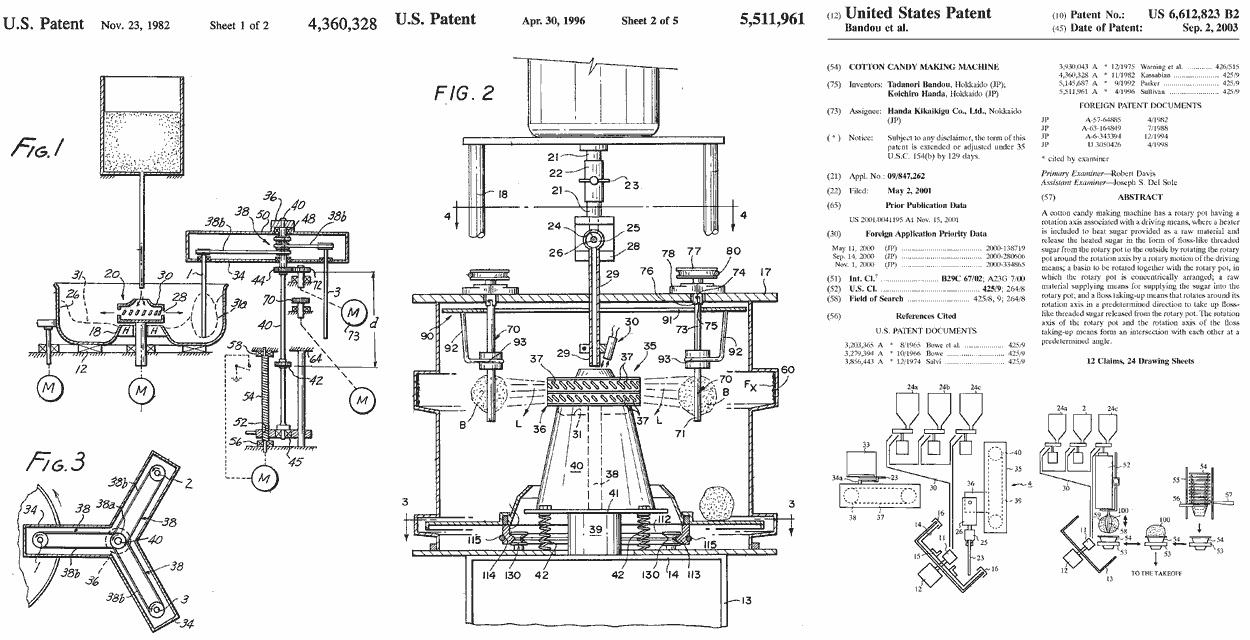
For this kind of production, which is already mass-produced, completely different equipment is needed—namely, automatic machines that would continuously produce cotton candy, divide it into portions, and transfer it for packaging. And such machines have been created. Here are three patents for similar machines, all operating on the same principle.
|
Automatic machines for the production of cotton candy.
U.S. Patents 4,360,328, 5,511,961, and 6,612,823 |
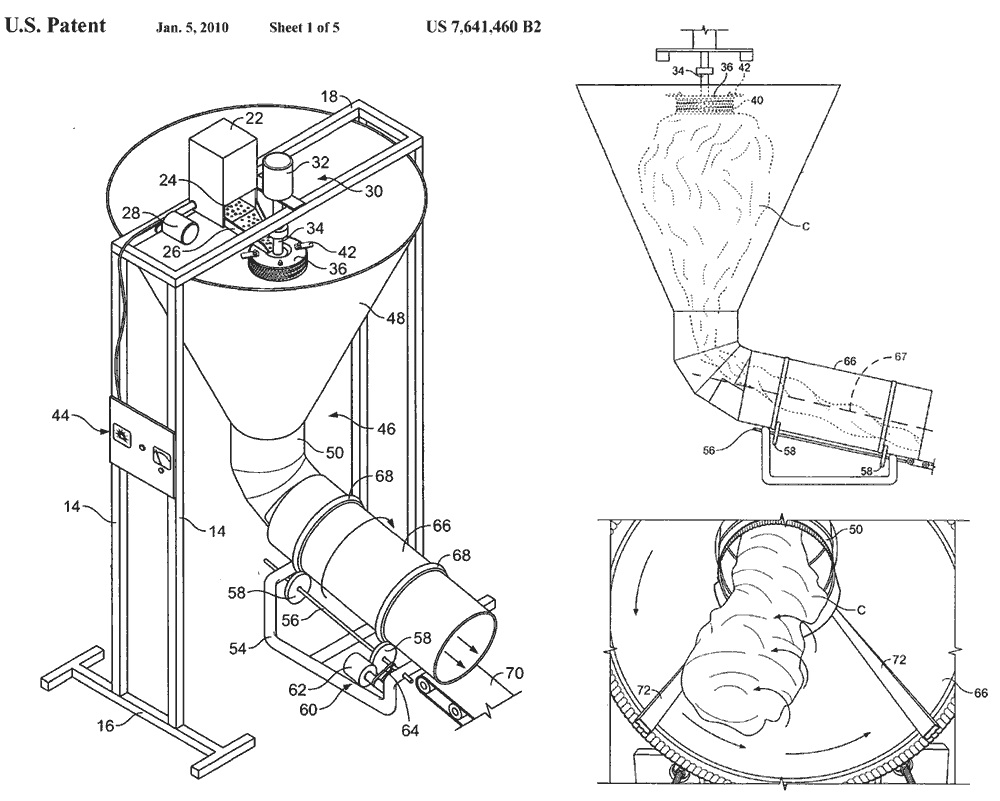
Here is another machine, but it works on a slightly different principle.
|
Patent US No. 7641460. Cotton candy handling device. |
More than a hundred years have passed since the invention of the cotton candy machine. Although the principle of making cotton candy has remained virtually unchanged, technology and techniques have advanced significantly since the first machines. This is not surprising, as this type of business has evolved far beyond the market stalls, becoming a full-fledged branch of the food industry. However, even today, in any crowded place, you can see a cotton candy vendor with his machine, surrounded by children and their parents. Some are starting their own business, others are reminiscing about their childhood, and still others are simply enjoying life.
The author of the article is Alexander Mitkevich.
<The product block will be here>
A complete list of cotton candy machines offered by our company.