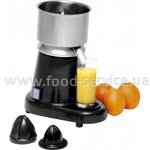
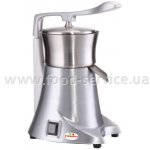
Freshly squeezed juice is not only a healthy but also a delicious alternative to packaged juices, artificial carbonated drinks, and other beverages. To produce healthy fresh juice in bars, a professional juicer is needed that meets the following key criteria:
- it will make healthy and lively juice;
- the device must be simple and easy to use;
- the juicer is designed for commercial use and can withstand long-term loads;
- The juicer must operate reliably, ensuring the stable operation of the establishment, be it a bar, cafe, restaurant, or fresh juice outlet.
With so many different types of juicers on the market, it can be difficult for potential buyers to decide which one is best. To help you make your choice, we recommend reading positive and negative reviews of professional juicers on the Food-Service website. In this short article, we'll help you choose the best option for your business.
In previous articles, we've already described the classification of juicers. Let's briefly recap.
According to their intended purpose, juicers are divided into professional and household.
We'll cover the former in more detail in this article. For more information on choosing a home juicer, see our articles "How to Choose a Juicer for Your Home" and "Auger Juicers: A Unique Juicing Technology."
Juicers are divided by their operating type (principle of operation):
- centrifugal
- auger
- electric citrus juicers, in the form of a press with manual pressing without a lid
- electric citrus juicers, in the form of a press with a manual clamp and a lid
- manual mechanical presses.
Each type includes both professional and consumer models. We'll focus on the professional models.
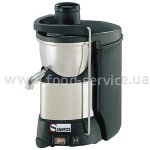
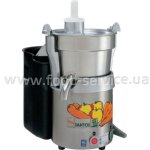
Centrifugal juicers. Until recently, the French company Santos held a significant share of the commercial juicer market, offering several time-tested models. The most popular models
are the #28, made entirely of stainless steel, and the #52, which features plastic fittings and a lid. The
#58 is an improved version of the #28. All juicers feature a robust frame, a massive sieve, and a reliable design.
In 2008, the ROBOT-COUPE juicer, model
J 80 Ultra, entered the Ukrainian market, and a little later, the more powerful model
J100 In 2008, the ROBOT-COUPE
J 80 Ultra juicer entered the Ukrainian market, followed shortly by the more powerful
J100 model with automatic pulp ejection and the less popular
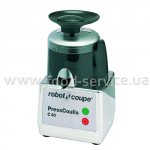
C40 Press Coulis model without automatic pulp ejection. The latter also features a cylindrical strainer, allowing for every last drop of juice to be squeezed out. However, due to the need to disassemble the juicer and remove the pulp after every few glasses, it did not gain much popularity in the commercial market.
Auger juicers. After extensive research, the Korean company Hurom, a pioneer in this field, concluded that vitamins, microelements, and beneficial properties of juice are better preserved with low-speed extraction. This technology prevents juice from overheating and reduces oxidation, making it more nutritious. Consequently, auger juicers with horizontal augers were developed (since 1974), and later, in 2007, vertical augers. Although auger juicers are primarily intended for household use, they can also be used commercially for small batches. It's important to remember that low-speed juicers can typically run continuously for no more than 30 minutes.
For more information on auger juicers, see the article
"Auger Juicers - A Unique Juicing Technology ," which details the advantages of these juicers.
Electric citrus juicers, press-type with manual pressure without lid Manually powered juicers with a press and motor are popular in many bars. At first glance, these juicers seem to be cheaper than those with a press, while offering the same functionality. However, a closer look at their design reveals that, unlike the latter, they have cheaper components (usually a plastic cone instead of a metal one) and lack some features (such as an idle protection device). Despite this, some bartenders are accustomed to and comfortable using these electric citrus presses. In our personal opinion, holding the product by hand on the rotating cone is not very convenient. Furthermore, there's no time savings, as while saving time feeding the product to the cone (there's no lid, so we don't have to spend time placing the product on the cone under the lid), we lose out on the speed of extraction. After all, with a lid, we press carefully, while with a handheld press, we press boldly and quickly. Despite this, the choice is always up to the buyer.
There are a lot of juicers in this class; below we list the most popular models.
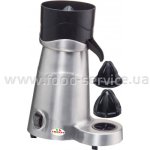
Electric citrus juicers, press-type with manual pressure and lid Juicers with a press have become more popular than juicers without. These models typically use higher-quality and more expensive components. Importantly, they feature a dead-run protection system. It works as follows: when the product is placed on the cone, the lid is raised, preventing the cone from rotating, preventing accidental activation and hand injury. This is achieved by a special microswitch, which is linked to the position of the lid or shaft. Once the lid is pressed against the product, the protection system is disengaged, the shaft and cone rotate, and the juice extraction process begins.
The vast majority of models with a pressure-sensitive cone are made of metal, making them more reliable and durable. The frame (housing) is also made of metal—cast aluminum or stainless steel. The most popular models are produced by European companies
: Macap (Italy) ,
Ceado (Italy ),
Santos (France ),
Frosty (Italy ),
Bartscher (Germany ),
and Sirman (Italy) . It's especially worth noting that the first three companies assemble their juicers in Europe, resulting in a slightly higher price than the latter. Furthermore, in our opinion,
Macap juicers are easier to maintain and assemble.
Manual mechanical presses .
Manual mechanical presses are the ideal solution for juicing pomegranates and citrus fruits. Because the cone doesn't rotate, these juicers easily produce high-quality, pure pomegranate juice. Other juicers can be challenging to obtain: centrifugal and auger juicers can introduce ground pomegranate seeds into the juice, which imparts a bitter taste. In motorized citrus juicers, both with and without a press, the rotating cone causes the pomegranate seeds to fly out of the juicer, making the process somewhat awkward. Covering the fruit and the top of the juicer with a plastic bag is necessary to prevent juice and seeds from splashing. Manual presses, however, eliminate this problem: simply cut the pomegranate in half, place it on the cone, and press. Important factors when choosing a juicer include its weight and quality of construction. A 300 UAH silumin press won't provide the necessary stability or sufficient pressing force. Furthermore, such juicers can break down within the first month of use. At Food-Service, we offer models that have been proven in our own kitchens and by our customers. Trusted brands include Maskot (Turkey), Beckers (Italy), and Frosty (Italy), all of which are of good quality. All juicers from these brands are impressively heavy, weighing between 5 and 8 kg, and are well-made. Juicers are available with either rack-and-pinion or lever systems. Both are quite convenient. The rack-and-pinion system is more common; it offers a smoother pressing process, but requires more turns of the handle (there are several). With a lever system, the handle simply drops down while pressing down, but requires a greater initial force. Choose the option that suits you best from the list below.
<The product block will be here>
This article is copyrighted by Food-Seovis. Copying without citing the source and a link to the website is prohibited.