Introduction .
Food is one of the main sources of energy for humans. Almost no event is complete without lunches, coffee breaks, dinners, and suppers. What's even an event about? How much food is required to keep kindergartens, schools, medical facilities, business centers, and other businesses supplied? And don't forget about annual children's camps and off-site events.
With the rapid emergence of various services, rapidly increasing service levels, and competition, HoReCa businesses are forced to constantly seek new solutions to optimize production processes and save time and resources.
A key factor in the food industry's focus on maintaining sanitary standards is its emphasis on hygiene and cleanliness. Hygiene and cleanliness are essential during the production process. But what happens if the production process—food preparation—occurs in a specially designated area, but distribution to the consumer occurs elsewhere? Prepared dishes must be transported and served in exactly the same condition as when they were first prepared—hot, fresh, and, most importantly, in compliance with all sanitary and hygienic standards.
Food containers .
To address food transportation challenges, various
containers , such as
thermal buckets , thermal boxes , and
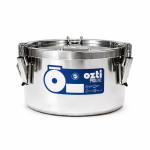
thermal containers , have been developed. These are specialized containers designed for the storage and efficient transportation of food products, ingredients, and semi-finished products. They are typically cubic, cylindrical, or rectangular in shape, with hermetically sealed lids.
Types of containers and specifics of use .
Food transport containers are available for both first and second courses. A hermetically sealed lid allows for the transport of food without any spillage or contamination. If maintaining a specific temperature (cold or hot) is not essential,
standard containers without additional insulation are typically used. These are called simple
food transport containers with a single wall and lid. When it's possible to reheat food immediately before serving,
containers with a special double bottom are preferred. This allows the container to be placed on the stovetop and brought to the desired temperature. Such containers are called
double-bottom or sandwich-bottom containers . Finally, when maintaining a specific temperature (cold or hot) for a specific period of time is essential, containers with insulated walls are used, limiting heat transfer between the interior and the outside environment. Such containers are called
thermal buckets ,
thermal boxes , or
thermal containers .
Product temperature maintenance time .
One frequently asked question is: "For how long does
a thermobox maintain the temperature of a product?" While some manufacturers specify heat or cold loss figures for a specific period of time, unfortunately, these figures are often inaccurate. This factor directly depends on each specific product, its initial temperature, and the ambient temperature.
Container design options .
There are many different types of food transport containers:
containers ,
thermal buckets ,
thermal boxes , and
thermal containers . Each of these can come in a variety of shapes and sizes, suited to different applications depending on the specifics of each task. The Food Service Company online store offers the most common and basic types of containers:
 Specifics of transportation.
Most containers are designed to be stacked during transport, saving space and allowing for the storage of large numbers of containers.
How to choose a container , thermal bucket , thermal container , thermal box for transporting food?
To make the right choice and purchase a food transport container, you need to determine several important points: