What's the current state of the office lunch delivery system in Kyiv? 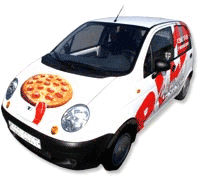
This system has been in place for about 10 years. The market size can be estimated at approximately $2 million per year. At the end of 2006, there were more than 30 food delivery companies in Kyiv.
They can be divided into those that have their own restaurant or café, such as "Dva Gusya" (Two Geese) and "Puzata Khata" (Bloody Hata), and those that don't, such as "Maria Magdalena" and "ChP Kordelia," among others. The first category of businesses deliver dishes from their standard menu, familiar to customers at their stores. They typically promote their delivery services through a website or printed materials.
Companies in the second group develop their menus specifically for delivery and change them frequently. Their primary marketing channels are the internet and direct mail to offices. In addition to delivery, these companies also provide large-scale catering (any food delivery outside the kitchen is considered catering, so lunch delivery can be considered small-scale catering). Large-scale catering includes banquets and buffets, with an average order price of 150-200 UAH per person and a minimum of 50 guests.
Large-scale catering is a much more profitable business than smaller lunch delivery. To avoid bankruptcy, a lunch delivery business needs at least one regular customer who can ensure a stable profit by ordering a certain number of lunches daily. But not everyone succeeds. Cases of businesses relying solely on occasional orders going bankrupt are quite common. However, some specialized companies (excluding cafes) have been around for many years, and all this time they have focused primarily on delivering inexpensive lunches to offices. Their main competitors are so-called "babushkas," who have long since taken up preparing even cheaper lunches and delivering them to workplaces. The advantage of these businesses over home-based workers is that they are responsible for the quality of their products, making it less likely to cause food poisoning.
Compared to European countries, our delivery market is very underdeveloped. Competition is currently low, and the market has room to grow, as the trend of frequent food orders to the office has only recently emerged, and ordering food home is still relatively uncommon, despite being very popular worldwide.
Does this type of food compete with restaurants? If so, what price range?
If they do, it's primarily for low-price restaurants. Because the average price of a custom-made lunch is 15-20 UAH, roughly the same as a meal at a lower-price establishment.
Office lunches are typically ordered when there's a lot of work to do, no time to grab lunch, and instant soups or sandwiches aren't in the mood. Or management may decide to centralize meals for employees in the office out of concern for their well-being or to save time. Potential lunch customers are those in offices without affordable food options nearby. If such a location is nearby, it's more convenient and quicker to visit them rather than wait for delivery. This means the volume of food delivered remains fairly modest, and while it offers little competition to restaurant dining, it's still only marginal.
If we talk about companies that own their own cafes and then offer a delivery service, not only are they not cutting off their own customers, but, on the contrary, they're expanding their clientele by attracting people who live too far away to travel to eat there but who really love the restaurant's cuisine. For such businesses, delivery is an expansion of their business.
How developed is the food delivery system in Europe, and what are the differences between the European and Ukrainian systems?
- Much more developed. In Kyiv, for a population of 3 million, just over 30 companies deliver meals, which is very few. This is because it's not common to order food home. In Europe, half of all delivery orders are for home delivery. In France, for example, Japanese food delivery is very popular: almost every second family orders it. In many European countries, cooking at home is generally not common. It's considered much better to order food home or go to the nearest cafe. Here, we consider a housewife unprofessional if she can't cook a first, second, and third course. People might also be afraid to let strangers into their home, even if they're a delivery person. Furthermore, cooking your own food is significantly cheaper than ordering food. As a result, the average family spends a lot of time preparing food.
However, society is not standing still – the number of food delivery companies is growing. In 2006, eight new companies opened.
I haven't yet touched on the issue of mid- and high-end food delivery. Many high-end restaurants offer this service. It's used by those who really love the restaurant's cuisine but can't always get there, or if the restaurant offers dietary options. This service represents a very small segment of the market, and is used primarily by VIP clients.
- What are the prospects for the development of this infrastructure in Kyiv?
As the city grows, and the number of people and offices increases, the prospects are very good. Especially the prospect of developing home delivery, which is practically nonexistent today. I think it will develop, because the logical path of development for any society is to reduce the time and effort spent on physical labor. Today, city dwellers don't plow a field or build a house with their own hands to eat—there are specially trained people for that. They work so that others don't waste time on such labor and have time for their own business. And a situation where a woman, having worked from morning until night, comes home without spending hours at the stove is considered quite normal in such a society. As the development of European civilization has shown, society sooner or later reaches this state. And as incomes rise and more and more families can afford to regularly visit restaurants, the market will develop. But since social improvement occurs very slowly, the market will expand by a maximum of 4-5% per year. This will mainly occur due to the already existing fast food restaurants, which do not yet have a delivery service. This type of business expansion is very profitable, as you already have the production facilities, staff, and transportation to deliver the products—nothing more than a small advertising campaign is required. Moreover, competitors have already established this service.
Pizza delivery (both to the office and home) is already a profitable and promising option. This is primarily because it's incredibly popular, and secondly, because almost no one knows how to make it at home. Despite this, not all pizzerias offer delivery. Some have tried, but due to management errors, it didn't work out, while others are simply too lazy. As a result, ordering pizza on holidays and Fridays is extremely difficult, and the wait time is extremely long. In other words, demand exceeds supply.
At the moment, most office workers continue to eat sandwiches because most companies do not have a regular food delivery service.