-
About everything
- Characteristics
- Description
- Photo / Video(1/2)
- Accessories / Spare parts
-
Technical specifications
| Availability of an oven |
Without oven |
| Burner shape |
Flat |
| Control type |
Electronic |
| Installation type |
desktop |
| Number of burners, pcs. |
4 |
| Power, kW |
12 |
| Presence of convection |
None |
| Voltage, V |
380 |
| Overall dimensions (L x W x H), mm |
750x810x158 |
| Weight, кг |
28.00 |
| Burner dimensions, mm. |
300x300 |
| Frame |
stainless steel |
| Maximum glass load, kg |
60 |
| Power adjustment, W. |
500-3000 |
| Slab covering |
glass |
| Operating temperature range, °C |
80-240 |
All characteristics
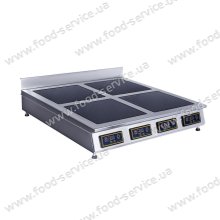
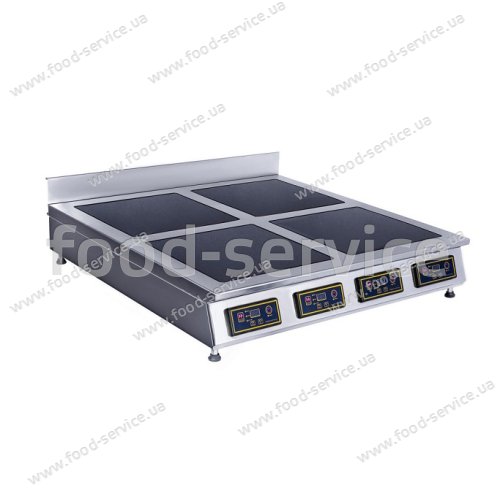
Description. Induction hob Sit 4.12 Skvara Innovations
Induction hob Skvara Inovations Sit 4.12 with 4 burners, tabletop. Features of the model: 1. Body: stainless steel grade AISI - 304, 1.5 mm thick. 2. Work surface: glass ceramic, size of one burner 300x300 mm. 3. Improved heating, without a heat spot due to the new inductor model. 4. Power of one burner: 3.0 kW. 5. 36 programming levels, double adjustment, by temperature and power. 6. Recipe table with tips for preparing different dishes for induction cooker. 7. Load per burner: up to 70 kg. 8. Connection: 380 V. 9. Installation: desktop. A distinctive feature of Skvara Innovations induction cooktops is their high reliability and suitability for use in professional kitchens. Unlike cheap Chinese induction cooktops, Skvara cooktops are assembled entirely in Ukraine using components from reliable manufacturers. After assembly, each burner undergoes 1.5 hours of testing on a special rig under maximum load. Externally, an induction cooktop is no different from a similar conventional glass-ceramic electric stove. The key difference is that in a conventional stovetop, heat is generated by a heating element and transferred to the pan through the glass-ceramic surface. An induction cooker has no heating element at all: heat is generated in the bottom of the cookware by an electromagnetic field created by a special induction coil. Thanks to the shortest path for converting electrical energy into heat, induction cooktops offer several advantages over their competitors: they heat up quickly and consume less energy. Suitable for induction cooktops: steel and enameled steel cookware, cast iron cookware, stainless steel cookware with a ferromagnetic bottom, and aluminum cookware with a ferromagnetic bottom. Cookware made of aluminum, copper, brass, stainless steel, glass, ceramic or porcelain is not suitable. Induction cooktops are very easy to clean. On conventional glass-ceramic burners, spilled liquids tend to stick to the surfa...
Read in full
|
|
Video. Induction hob Sit 4.12 Skvara Innovations
| Subscribe to the video channel food-service.com.ua |
|
Accessories for Induction hob Sit 4.12 Skvara Innovations
: 15332
Order
made to order
Protection unit for Skvara induction cookers with 4 burners, each with a power of up to 3.5 kW inclusive. An induction hob is modern equipment that requires proper operation and professional connection to the electrical network. If your establishment doesn't have a voltage stabilizer, we strongl..
|
-
Technical specifications. Induction hob Sit 4.12 Skvara Innovations
| Availability of an oven |
Without oven
|
| Burner shape |
Flat
|
| Control type |
Electronic
|
| Installation type |
desktop
|
| Number of burners, pcs. |
4
|
| Power, kW |
12
|
| Presence of convection |
None
|
| Voltage, V |
380
|
| Overall dimensions (L x W x H), mm |
750x810x158
|
| Weight, кг |
28.00
|
| Burner dimensions, mm. |
300x300
|
| Frame |
stainless steel
|
| Maximum glass load, kg |
60
|
| Power adjustment, W. |
500-3000
|
| Slab covering |
glass
|
| Operating temperature range, °C |
80-240
|
|
|
-
Description. Induction hob Sit 4.12 Skvara Innovations
Induction hob Skvara Inovations Sit 4.12 with 4 burners, tabletop. Features of the model:
1. Body: stainless steel grade AISI - 304, 1.5 mm thick.
2. Work surface: glass ceramic, size of one burner 300x300 mm.
3. Improved heating, without a heat spot due to the new inductor model.
4. Power of one burner: 3.0 kW.
5. 36 programming levels, double adjustment, by temperature and
power.
6. Recipe table with tips for preparing different dishes for
induction cooker.
7. Load per burner: up to 70 kg.
8. Connection: 380 V.
9. Installation: desktop.
A distinctive feature of Skvara Innovations induction cooktops is their high reliability and suitability for use in professional kitchens. Unlike cheap Chinese induction cooktops, Skvara cooktops are assembled entirely in Ukraine using components from reliable manufacturers. After assembly, each burner undergoes 1.5 hours of testing on a special rig under maximum load.
Externally, an induction cooktop is no different from a similar conventional glass-ceramic electric stove. The key difference is that in a conventional stovetop, heat is generated by a heating element and transferred to the pan through the glass-ceramic surface. An induction cooker has no heating element at all: heat is generated in the bottom of the cookware by an electromagnetic field created by a special induction coil.
Thanks to the shortest path for converting electrical energy into heat, induction cooktops offer several advantages over their competitors: they heat up quickly and consume less energy. Suitable for induction cooktops: steel and enameled steel cookware, cast iron cookware, stainless steel cookware with a ferromagnetic bottom, and aluminum cookware with a ferromagnetic bottom.
Cookware made of aluminum, copper, brass, stainless steel, glass, ceramic or porcelain is not suitable. Induction cooktops are very easy to clean. On conventional glass-ceramic burners, spilled liquids tend to stick to the surface. With an induction burner, things are much simpler: spills don't stick, and the cooktop can be cleaned immediately. Furthermore, even wiping up spilled milk, for example, with a simple cloth, is enough. The phenomenon of electromagnetic induction was discovered by Michael Faraday in 1831. Today, restaurateurs, among others, can thank the brilliant Englishman: the principle he discovered underlies the operation of induction equipment, which has been used in HoReCa kitchens for nearly two decades.
A new high-tech, highly efficient product—induction cooktops—has appeared on the Ukrainian professional kitchen equipment market. What are the advantages and disadvantages of induction cooktops, what does the market offer Ukrainian consumers, and what criteria should restaurateurs consider when choosing this type of equipment? We'll try to answer these questions.
Advantages of the technology
An induction cooktop is an electric cooktop with a glass cooktop equipped with induction burners. It differs from all other types of cooktops in the way heat is generated. In electric cooktops, heating occurs in stages: heat is transferred from the heating elements to the surface of the burner, which then heats the bottom of the cookware, and from the bottom, heat is transferred to the food. Induction cooktops skip the step of transferring heat from the hot surface of the burner to the cookware.
An induction cooktop operates by harnessing magnetic energy. In this case, a copper coil and high-frequency electric current generate heat directly in the cookware's base, which then heats the food. This means it's not the cooktop itself that heats up, but the pot or pan itself.
The surface of an induction cooktop typically heats up to no more than 60°C (140°F) and cools down in just 6 minutes after being turned off. This is because the cooktop is heated solely by the hot pan. By comparison, a gas cooktop at the same temperature cools down in 24 minutes, and an electric one in almost 50. This is an advantage in the kitchen, as the surrounding air is virtually unheated.
"This is especially noticeable if the kitchen is fully equipped with induction cooking equipment. In that case, we use other air conditioning options, as a less powerful ventilation system is required. An induction cooktop creates a different microclimate in the kitchen, allowing cooks to work in a more comfortable environment."
Induction cooktops offer a wide range of heating power—from 500 to 3500 watts. This power can be smoothly adjusted using a variety of settings. At the lowest setting, you can simmer food as if it were simmering, while at the highest setting, water in a pot boils faster than on a gas stove.
Induction cooktops combine the advantages of other heating equipment: they can provide extremely precise heating—down to the degree—which is an advantage of electric cooktops, while any temperature change occurs instantly, like on a gas stove.
In terms of cooking speed, an induction burner is comparable to gas burners and approaches that of microwave ovens. Water boils significantly faster on an induction burner than on any other stove, including gas (1.5 liters of water can be boiled in 3.2 minutes, compared to 14 minutes on a standard electric burner).
Will it save time and money?
One of the main advantages of an induction cooktop is its energy efficiency. Due to its cooking technology, induction cooktops save not only time but also energy. The cooktop consumes several times less energy than any other type. This is because the heating mode is adjusted according to the pan's configuration, allowing for the optimal setting to ensure minimal energy consumption. This means the cooktop automatically adjusts to the pan's bottom diameter and heats only the required surface area.
The stove won't start without a pan on it. Moreover, if the pot or pan is empty, the stove won't turn on either. Incidentally, a special sensor prevents heating of items smaller than 12 cm in diameter. So, if a spoon, fork, or knife is accidentally left on the stove, they won't heat up and there's no risk of burns.
Undoubtedly, a positive aspect is that cooking on an induction cooktop eliminates smoke and fumes. Food accidentally spilled on the glass-ceramic surface doesn't burn, as the burner itself doesn't heat up. Furthermore, induction cooktops are safe—they have no open flames, hot burners, or mechanical parts, reducing the risk of burns and fires. To ensure mechanical safety, the cooktop's corners are rounded.
This type of stove is easier to maintain: its surface is completely smooth, leaving no room for dirt to accumulate. And since it barely heats up, maintenance is as simple as periodically wiping the surface with a damp cloth.
Although an induction hob can successfully replace not only an electric hob but also a gas hob, it still has certain disadvantages.
Only special cookware with a bottom made of
Ferromagnetic alloy. This includes cookware made of stainless steel, aluminum with a ferromagnetic bottom, and cast iron. However, cookware made of copper, brass, aluminum, heat-resistant glass, and other non-magnetic materials is useless on this type of stove. Typically, cookware suitable for induction is marked with a special pictogram.
An expensive pleasure
The first induction cooktop was introduced by the German company AEG back in 1987, but initially failed to gain widespread acceptance due to both its high cost and consumer wariness of the new heating principle. However, professionals soon showed interest in the new technology. In the restaurant industry, cooking speed and quality are paramount. However, progress continues, and with increasing mass production, the technology is becoming cheaper every year, reaching prices comparable to traditional stovetops.
All products are of very high quality. The advantage of induction cooktops over traditional ones, which can be decisive when restaurant owners choose kitchen equipment, is, of course, the significant energy savings. Westerners have long calculated the economic benefits of purchasing induction cooktops; they know that in this case, the money won't be wasted. These cooktops have a very high self-sufficiency rate.
Before you make a choice…
Consumers are offered a variety of induction equipment. Their differences lie in design and concept:
Tabletop induction cookers and stationary floor-standing ones, which can be used as part of a thermal technology line.
Of course, induction has many advantages, and it generally improves the quality of production. However, before opting for it, you should carefully calculate the volume of food you plan to cook on the stove.
Based on this, we need to determine the volume of induction cooktops we want to install. It may be much more convenient to install a single surface with 6 cooking zones in a given kitchen than to install 6 small single-burner cooktops, and vice versa. This needs to be taken into account.
An induction cooktop combines an innovative approach with a compact design. It's ideal for presentations, off-site catering, kitchens with limited space, and areas where installing a gas stove is technically impossible. A mobile induction wok is ideal for catering, while a 4-burner induction stool or a 6-burner cooktop will be a valuable addition to a chef's kitchen.
According to experts, induction in our professional kitchens is a technology of the future that is sure to find its way into the market. Yes, it's still relatively new to Ukraine, and not all restaurateurs are aware of its existence. But the savings in energy, time, and effort, the safety and cleanliness of the kitchen, and most importantly, the speed and quality of customer service in the restaurant industry, as they say, are worth a lot. In today's successful business, the saying "time is money" always holds true.
Included. Induction hob Sit 4.12 Skvara Innovations
- induction cooker
- instructions
- 12-month warranty
- package
-
Фотографии. Induction hob Sit 4.12 Skvara Innovations
Видео. Induction hob Sit 4.12 Skvara Innovations
| Подписаться на видео канал food-service.com.ua |
|
-
Accessories for Induction hob Sit 4.12 Skvara Innovations
: 15332
Order
made to order
Protection unit for Skvara induction cookers with 4 burners, each with a power of up to 3.5 kW inclusive. An induction hob is modern equipment that requires proper operation and professional connection to the electrical network. If your establishment doesn't have a voltage stabilizer, we strongl..
|
|










 Popular products


